


Everyone’s piping Plaud transcripts into Obsidian right now. That’s table stakes. The flow that honestly changes the game is what happens when your reading enters the same system as your conversations — and it takes one more MCP to get there.
Let me give you the whole build, then the payoff.
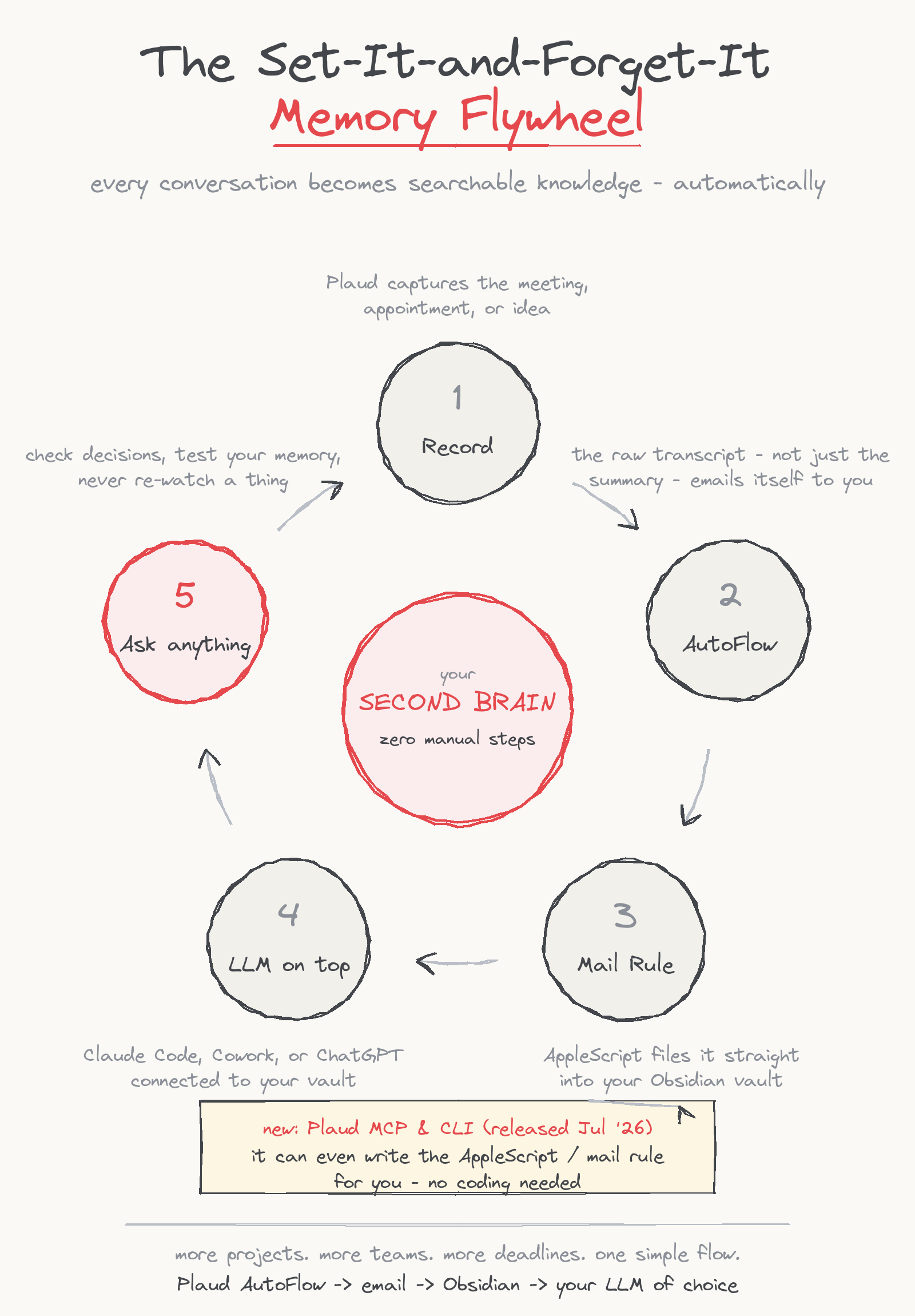
Step 1 — Turn on AutoFlow. In Plaud Desktop, enable AutoFlow. Select your transcript meeting and choose a template that will transcribe the content and send you an email.
Step 2 — The email is the document. The body of that email is what was transcribed and summarized — the summary and the raw transcript as one document. That distinction matters. Summaries are lossy; the raw transcript is the source of truth. I’m using Gmail, but any inbox works.
Step 3 — Set the Mail rule. In Apple’s native Mail application, create a rule that looks for emails from that sender. Filtering on the sender makes this foolproof, rather than having it generically pull content.
Step 4 — Let your LLM write the script. Ask Plaud or your LLM of choice to write an AppleScript that automatically grabs the contents of the email — both the summary you configured and the raw transcript — and sends it to a designated path in your Obsidian vault. You don’t need to know how to code. You just need to know what you want.
From that point on: you’re driving home, you’re on a walk, you’re listening to a book and an idea hits. You record it on your Plaud, and that’s it — as long as your MacBook or Mac Mini is connected with Mail open, every summary and transcript flows into your vault without you touching anything.
Now the part that actually changes your thinking. Connect the Readwise MCP. As you read books and capture highlights, that content enters the same system as everything you’ve said and heard. Open Claude Code or Cowork in your vault, reference any files, and the LLM can draw a line between what you’ve read, what you’ve said, and what you’re thinking — connections you simply weren’t making before.
And it works in both directions. You can validate what was actually said in a transcription — not what you remember being said. You can test an idea from your commute against a passage you highlighted three months ago. I believe this is what makes an LLM a genuinely better thinking and sparring partner: it’s not reasoning in a vacuum, it’s reasoning with your sources.
We’ve got more projects, more teams, more deadlines. Not because you can’t keep track on your own — but if you’re a busy parent working as a professional, this is what you need: a simple flow that is set it and forget it. That way, if you ever have questions, you can go back and check, or test your own thoughts against what was actually said.
Honestly, if you haven’t done this already, I feel like people have fallen behind. But sometimes modern-day problems require modern-day solutions, without overcomplicating things.