


My wife and I have been married ten years. Early on, when I was transitioning out of the military into corporate America, we made a deliberate choice: climb the ladder, build the cushion, and work toward what people call F-U money — enough saved that you work because you want to, not because you have to.
We’re not there yet. But we’re close enough to feel what that kind of optionality actually means. For our family, it means room to make decisions without panic. It means more resilience if one of us gets laid off, needs a break, or wants to spend more time at home with our kids.
This is the story of how I stopped spending entire weekends on spreadsheets and started getting a clearer financial picture over Sunday morning coffee — using Claude Cowork.
The goal was never just money
Financial independence sounds abstract until you attach it to a real decision.
For us, the win was never a number on a screen. It was optionality: the ability to make family decisions with more freedom and less fear. That mindset — being financially informed, not just financially comfortable — is what made our monthly review feel non-negotiable, even when life got louder.
What the old process cost us
For years, our financial review followed the same rhythm:
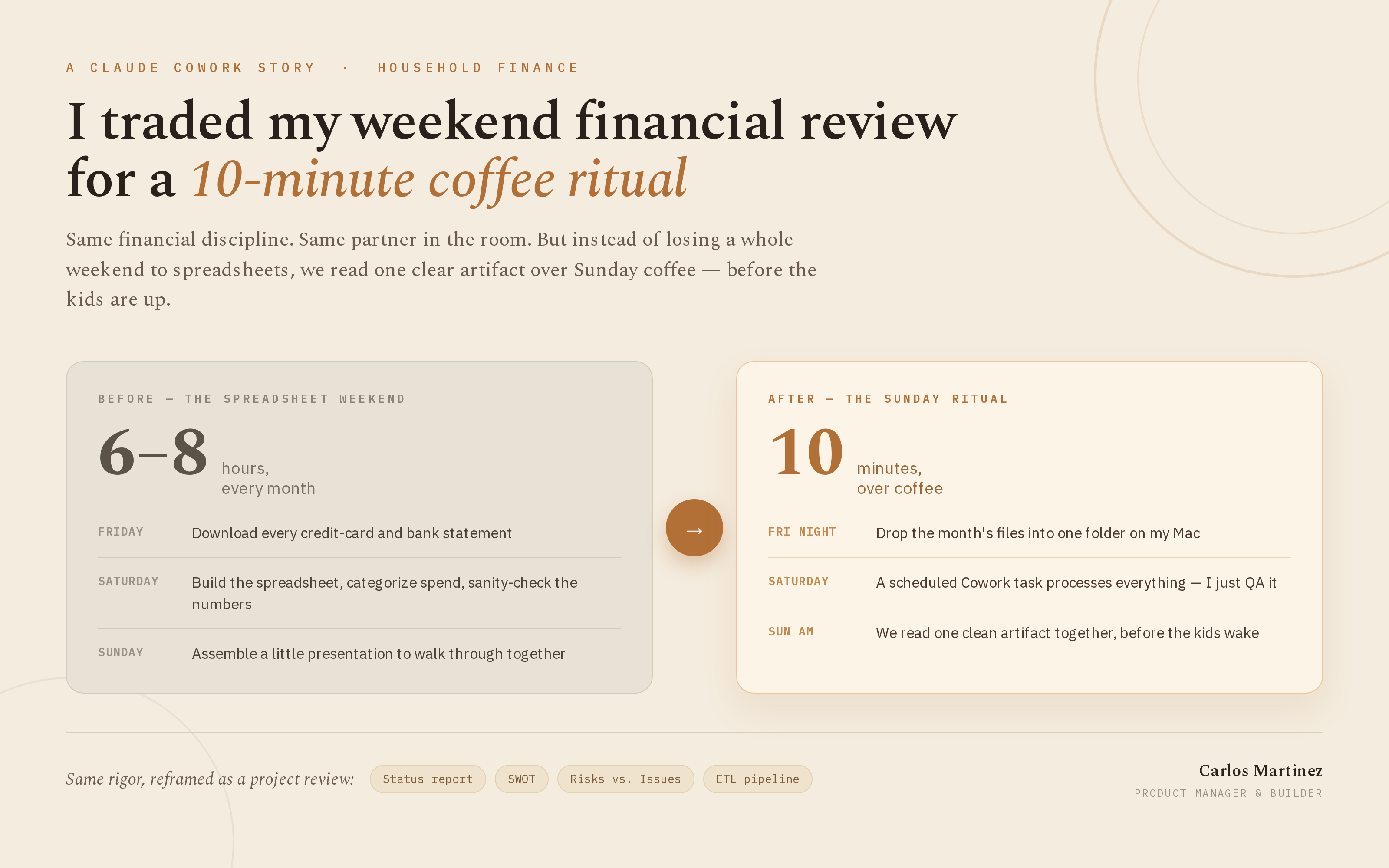
Friday: Download credit card and bank statements
Saturday: Build the spreadsheet, categorize spending, sanity-check the numbers
Sunday: Put together a short presentation for my wife — where we spent, how we were trending, what was working, and what wasn’t
It worked. We did fine. Before kids, losing six to eight hours over a weekend felt like an investment in ourselves.
Then we became parents.
You don’t know how much time you actually have until you have children. Someone told me that when I was eighteen. I finally understood it in my thirties.
Before kids: “Want to do this today?” “Nah, tomorrow.”
After kids: Has he eaten? Has he slept? Are we potty training? When did we last feed the baby? When did we change the diaper? If we travel, how long are we gone? What’s the pump situation? What needs to be cleaned before we leave?
Parenting turns your household into a mini logistics operation. If you’ve ever gotten a toddler out the door, through an event, and back into bed on time, you already know how to run a project with moving parts, tight deadlines, and zero tolerance for dropped balls.
The financial review didn’t become less important. It became harder to protect the time it required.
Why most finance apps weren’t enough
I tried the obvious route first: connect your accounts, let the app categorize everything, glance at a dashboard.
That part is fine. Aggregation is solved.
What’s not solved is the story.
Most financial apps tell you what happened. They rarely help you understand what you’re doing well, where risks are building, what decisions need attention, or how today’s spending connects to a goal six months out. Even good apps track and categorize well, but they often stop short of helping a household run a real review together.
I’m a product manager. I like timelines. I like visualizations. I like stakeholders being informed — and in this case, my wife is the most important stakeholder in the room. I wanted something closer to a project status report than a balance sheet.
That’s the gap I kept hitting.
I started treating our finances like a project review
Once I reframed the monthly review as project management instead of bookkeeping, the structure became obvious.
A good status report gives stakeholders a recurring snapshot of health against a baseline: accomplishments, schedule, budget, risks, issues, and clear asks (PMI). Our household finances follow the same shape.
Project management concept Our financial review Baseline plan Savings goals, vesting schedules, fixed obligations Schedule / milestones RSU vest dates, tax deadlines, big purchases Budget actuals vs. plan Monthly spend by category Risks Upcoming cash crunches, lifestyle creep, concentration Issues Categories already over budget Decisions / asks “Do we pause this subscription?” “Can we afford this trip?” Stakeholder My wife — the person who needs clarity, not raw data
The output I wanted wasn’t a chart. It was a decision-ready artifact we could read over coffee in five minutes.
Building the review in Cowork
When Claude Cowork launched, I started experimenting with whether I could compress the review without losing the quality of the conversation.
The first attempt was scrappy. Some formulas were wrong. Some categories were off. But the whole first pass took about forty-five minutes, and that alone told me the direction was right.
Over two weekends of focused build time, I got serious.
I created a Cowork project — a persistent local workspace with its own instructions, files, memory, and scheduled tasks.
On the data side, I built a simple pipeline around the same ETL pattern finance teams use in corporate environments — extract, transform, load.
Extract — Download statements and CSV exports from our institutions
Transform — Clean and normalize the data so categories stay consistent month to month
Load — Feed everything into the project so it can be reviewed against our baseline plan
One concrete example: different institutions export similar data with slightly different labels, date formats, and category fields. Before review, I normalize those columns so the same type of transaction lands in the same bucket every month instead of creating false changes.
The inputs aren’t exotic. They’re just complete:
RSU statements
Pay stubs
Checking account statements
Credit card statements
Brokerage and retirement account statements
Under the hood: the rules that keep the AI honest
The pipeline is the easy part. What makes the system trustworthy is a small set of data-integrity rules I wrote down once and now enforce on every session:
One source of truth. A single profile document holds every financial fact — income, obligations, accounts, goals. Every session loads it first, and it’s the only file that mutates. Everything else is a dated, immutable snapshot.
Every number carries a verification flag.
✅ verified against a document
🟡 estimate
❓ unconfirmed
The AI is not allowed to silently upgrade an estimate to a fact — a flag only changes when a source document says so.
Recompute independently. The AI re-derives the math instead of trusting a number because it’s written down. Twice this has caught errors I would have carried forward for months.
Hard guardrails. The AI never moves money, never executes anything, and never recommends a financial action without showing the trade-offs — pros, cons, and tax implications, with the numbers.
A reusable prompt library. Monthly review, cashflow forecast, tax estimate, “what if” scenario modeling — each one a documented, repeatable analysis instead of a fresh conversation I have to steer from scratch.
If you’ve ever written a playbook or a team working agreement, this is the same instinct. The AI is a capable new teammate; the rules are its onboarding doc.
What comes out the other side is a single HTML artifact — three tabs, clickable, clean enough that my wife and I actually want to open it.
Here is a sample of the flow
It answers the questions we care about:
Where did the money go?
Which categories are creeping up?
Where are we strong?
Where should we set alerts, the way you’d set monitoring thresholds in software?
What opportunities are we missing?
What weaknesses or threats need attention this month?
Not generic budgeting advice. Our story, told with our data.
The new ritual
Here’s what the workflow looks like now:
Friday night: Download the month’s files and drop them in a folder on my Mac
Saturday: A scheduled Cowork task processes everything; I do a quick QA pass to make sure nothing was missed
Sunday morning: Before the kids are up, over coffee, we review one artifact together
Total review time: about ten minutes. The downloads and the Saturday QA pass add a few more, spread across the weekend in gaps I’d lose anyway.
Compare that to the old six-to-eight-hour weekend.
The time savings are real. But the bigger shift is psychological. We’re not asking “Are we okay?” from a place of anxiety anymore. We can see the trend. We can name the trade-offs. We can celebrate what’s working and flag what needs attention without turning money into a fight.
What actually changed
Three things stand out.
1. The review tells a story, not just a total. We see strengths, gaps, opportunities, and threats in the same view. That makes the conversation productive instead of defensive.
2. It’s built for us, and it can grow with us. New account? Add it to the folder structure. New goal? Update the project instructions. We’re not waiting on a product roadmap.
3. It respects the season we’re in. I’m not looking for a fancier finance app. I’m looking for clarity without sacrificing the weekend. With young kids and a household that runs on routines, that matters more than any feature list.
The takeaway
If you’re already doing the work of being financially informed — downloading statements, tracking spending, trying to align daily decisions with long-term goals — you may not need another dashboard.
You may need a system that helps you review your finances the way you’d review a project: risks, trends, decisions, timelines, and a narrative your partner can actually engage with.
I invested two weekends upfront to build that system. Now I get that time back every month, with a better conversation at the end.
If this sounds familiar, here’s the before-and-after at a glance — and if you want to build your own, the structure is simple: one folder, one instructions file, one scheduled task, and a Sunday morning to read the result.
How do you run your household financial review? Reply and tell me — I’m especially curious if anyone else has hacked together their own system instead of using a budgeting app.
Carlos Martinez is a product manager and builder based in the U.S. He writes about using AI tools for personal productivity, family logistics, and the boring systems that make ambitious lives actually work.
Further reading (optional links for curious readers):