


1. Conclusion
Two questions keep coming up when people find out I am running my job search with AI.
What is your setup? And how are you handling the bias?
The second question is the better one. An AI will happily tell you that you are a perfect fit for a role you are not qualified for, and then write you a résumé bullet claiming a 40 percent improvement in something you never measured. That bullet gets you a first-round interview and ends your candidacy the moment someone asks a follow-up question. The tool is biased toward making you feel good and toward sounding confident. Left alone, it will flatter you straight out of the process.
I am also biased. I am a platform product manager, which means when I am anxious my instinct is to build a systeminstead of making the phone call. Building feels like progress. It is not.
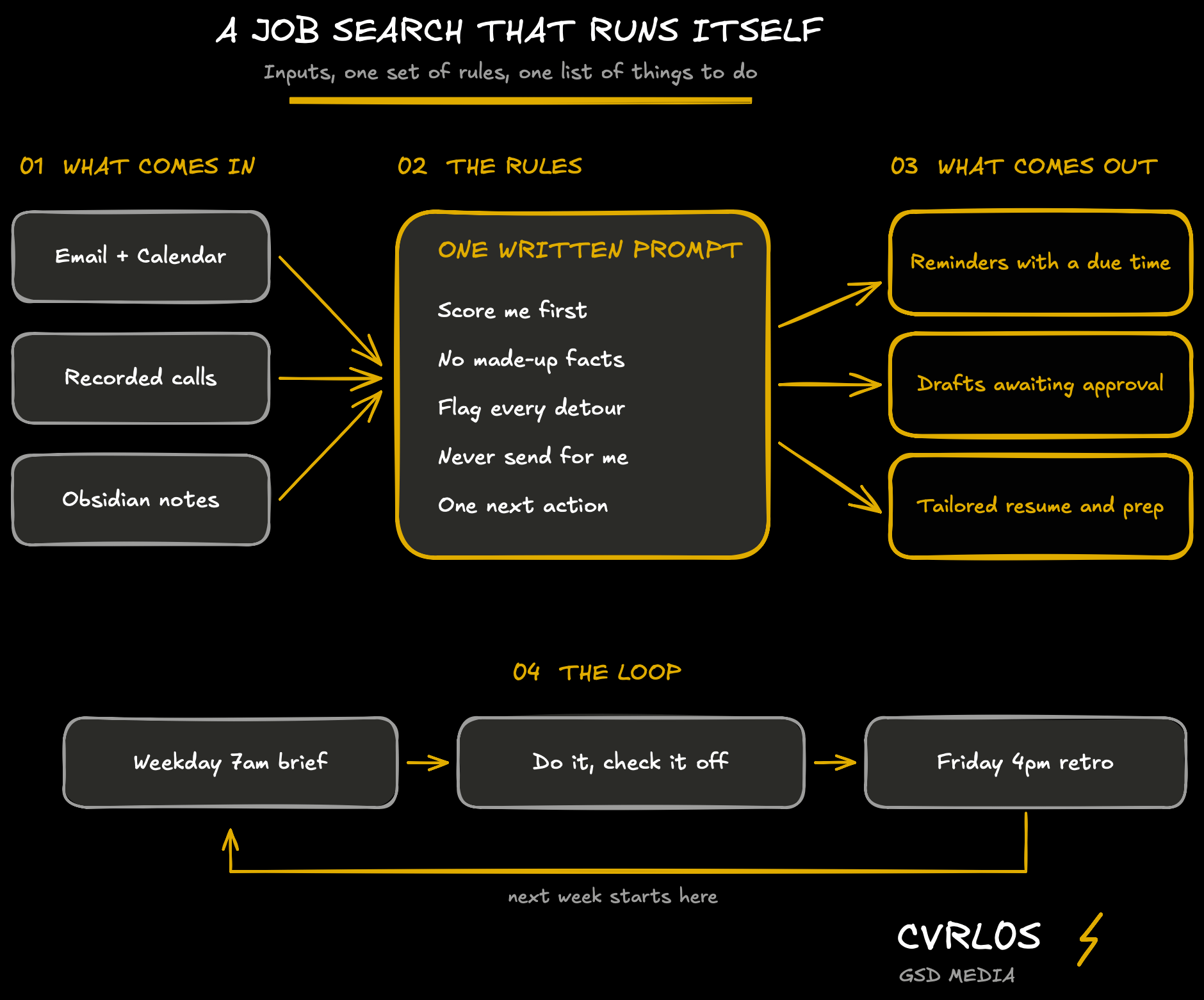
So my setup is designed around both of those biases rather than around the AI being clever. One strict written prompt that forbids unsupported claims and forces every detour to be named. One list of things to do. One schedule. Nothing new to maintain.
How is it working? Honestly, it is doing exactly one thing well: I no longer waste time deciding what to work on, and I no longer send anything out that I cannot defend in a live conversation. It has told me to skip roles. It has told me I was busy instead of productive. The interviews are still mine to win.
And the system is not the answer. It is the thing that clears the desk so I can do the actual work, which is talking to people. More on that at the bottom, because it is the highest-leverage hour of my day and it has nothing to do with software.
2. The Setup
The core is not a clever prompt. It is a strict one. A few pages long, doing four things.
It defines the mission narrowly. Roles where my actual experience applies: product management, developer platforms, developer experience, internal tools, product intake and prioritization, technical customer engagement, AI-enabled workflow automation. Optimize for quality applications, warm conversations, proof of work, and interview prep. Explicitly not for application volume.
It forces a scoreboard before anything else. Live processes, applications submitted this week, pieces shipped this week, deliverables due today, on-time status, blockers, recommended next action. I cannot open a session and chat. I get graded first.
It has an evidence standard. This is the bias answer, and it is the part I would steal if I only stole one thing. No inventing, inflating, or implying any fact not supported by my materials. When a claim is plausible but unsupported, it must be labeled one of four ways: needs confirmation, evidence gap, potential positioning angle not yet substantiated, or do not claim. Forcing the model to flag what it does not know turns it from a confident liar into a useful editor.
It has a focus protection rule. Any time I propose a new tool, dashboard, automation, or template, it must be named as a possible detour and challenged with one question: what shipped this week, and what active deliverable will this replace or accelerate? That rule exists specifically to catch me.
There is also a challenge rule. If I am on low-leverage work while something is due or overdue, it says so in four lines: observation, opportunity cost, recommended decision, smallest next action. No lecture, no shame.
3. Project
The project is a single Claude project I created on September 8, about a week after the layoff.
What lives in it:
Résumé versions. A baseline résumé plus a tailored version per role, all in Obsidian under
/projects/career-ops. Plain markdown files on my own disk. Not twelve files named Resume_Final_v3.Role dossiers. One per live opportunity: the job description, my evidence map against it, prep notes, and what was actually said in each round.
Canonical figures. One file of the numbers and scope claims I am allowed to use, with a source for each. Everything else gets flagged.
Interview debriefs. What the interviewer actually said, scored honestly, written within an hour of hanging up.
Hand it a job description and it does not write a cover letter. It runs a fixed workflow:
A recommendation first: pursue now, pursue if a warm path exists, pursue only with targeted positioning, monitor, or skip.
A fit assessment.
An evidence map, as a table, mapping each role requirement to real evidence and labeling the strength direct, adjacent, or missing.
The missing rows are the point. It is not allowed to hide a gap behind vague wording. It has to tell me the gap is there and whether it is fixable through positioning, a portfolio piece, a referral, preparation, or not fixable for this application.
4. Schedule
The cadence exists so that showing up is not a daily decision.
Weekday 7:00 AM Central. A morning brief runs on its own. Scoreboard, what changed overnight, what is due today.
Friday 3:30 PM. A pre-retro brief runs.
Friday 4:00 PM. A ten-minute retro. Wins, pipeline changes, applications, conversations, interviews, pieces shipped, what got missed, bottlenecks, lessons, and next week’s three priorities. That snapshot is stored so Monday does not start cold.
Monday 9:00 AM. A fifteen-minute plan.
Underneath, the working day is about six protected hours, split roughly three for the job search and three for GSD Media, my creative business.
I want to be honest about the failure mode. The schedule is easy. The six protected hours are the hard part, and I do not hit them every day.
5. Context and Tool Use
Almost none of this is new software. It is what was already on the machine, connected so it can be read and written.
Apple Reminders is the operating list. One list, called Deliverables. Every agreed task goes in with a specific due time. Checking the box is the only way completion is confirmed. The rule that keeps it honest: a deliverable does not exist until it has an outcome, an owner, a due date, a due time, a definition of done, and the source material needed to do it. If it is not in Reminders with a time, it does not exist.
Calendar holds the timed blocks, so six hours is visible rather than aspirational.
Mail and Calendar connectors let the morning brief see what came in overnight. Recruiter replies, scheduling requests, follow-ups I owe people. That is how what do I owe people today gets answered without scrolling an inbox.
Obsidian is the source of truth for career evidence, in
/projects/career-ops. Because the evidence lives in files I control, the evidence standard has something real to check against instead of the model guessing.Plaud, a small voice recorder, captures calls. The transcript becomes a written debrief while it is fresh, which is how what the interviewer actually said became a file instead of a fading memory.
Excalidraw for thinking in boxes and arrows, usually mapping how a product’s loop works before an interview.
One hard rule across all of it: the system never sends anything. It drafts emails and creates reminders. Every send, submit, and apply needs my explicit approval on that specific item, not blanket approval. I am not comfortable with an agent emailing a recruiter on my behalf, and I do not think you should be either.
The part that is not about productivity
The three hours on GSD Media are not a side hustle line item. They are how I cope.
A layoff takes the thing you owned away from you. Interview processes then hand you weeks of waiting on other people’s decisions, which is the same feeling again in slow motion. GSD is the project nobody can take from me. I own it, I manage it, I learn on it, and I put my actual skills to the test on it. When a process goes quiet or a rejection lands, there is still something moving that week.
Everyone copes in their own way. Mine is keeping momentum on something I control. That is the reason a piece ships every week, including this one.
The next best thing you can do is network like you are speed dating, with better taste
The system exists so I have time for this. This is the part that actually moves a job search.
Speed dating gets the pace right and the depth wrong. Most people run one or the other badly: either a hundred cold connection requests that go nowhere, or three coffees over two months. You want the tempo of the first with the judgment of the second.
That means doing the homework before you ever send a message.
Go through your connections. Then their connections. Then theirs. Slowly, on purpose.
Build a mental model of who you know and who they know. Not a spreadsheet. A map in your head that you can actually recall in a conversation.
Cluster them. By company, by function, by era of your career, by who tends to know everyone.
Then go get coffee and be Sherlock Holmes about it. Who might know the hiring manager. Who sat next to them two jobs ago. Who ran the team that the team you want reports into.
Enjoy that part. The detective work is genuinely fun, and it is the difference between asking a stranger for a favor and having a real reason to talk to someone.
Quality beats quantity, every time. A handful of meaningful relationships does more than two hundred connection requests, and it does it in both directions. The person on the other side gets something out of it too, which is the only reason it holds. Do it this way and you spend far less time doing mental gymnastics to justify why a stranger should help you, because they are not a stranger and you are not asking for a favor.
One last thing
If you are in this too, the part I would actually pass on is this: take control of the time.
Not in the productivity sense. In the sense that the waiting is going to happen whether or not you do anything with it, and you get to decide what fills it. Build something. Learn something that is yours and not a line on a résumé. Keep one thing moving that nobody can take away from you.
And do not give up. People are still hiring people, despite the wave of AI. The conversations are still conversations. The person on the other side of the table still has to decide whether they want to work with you, and that has not been automated away.
Go do the homework. Go get the coffee.
If you have questions about any of this, the setup, the prompt, the evidence rules, how I am running the week, reach out. cvrlos. I will answer.